Nobody Ever Went to Page 2 (Now They Can't)
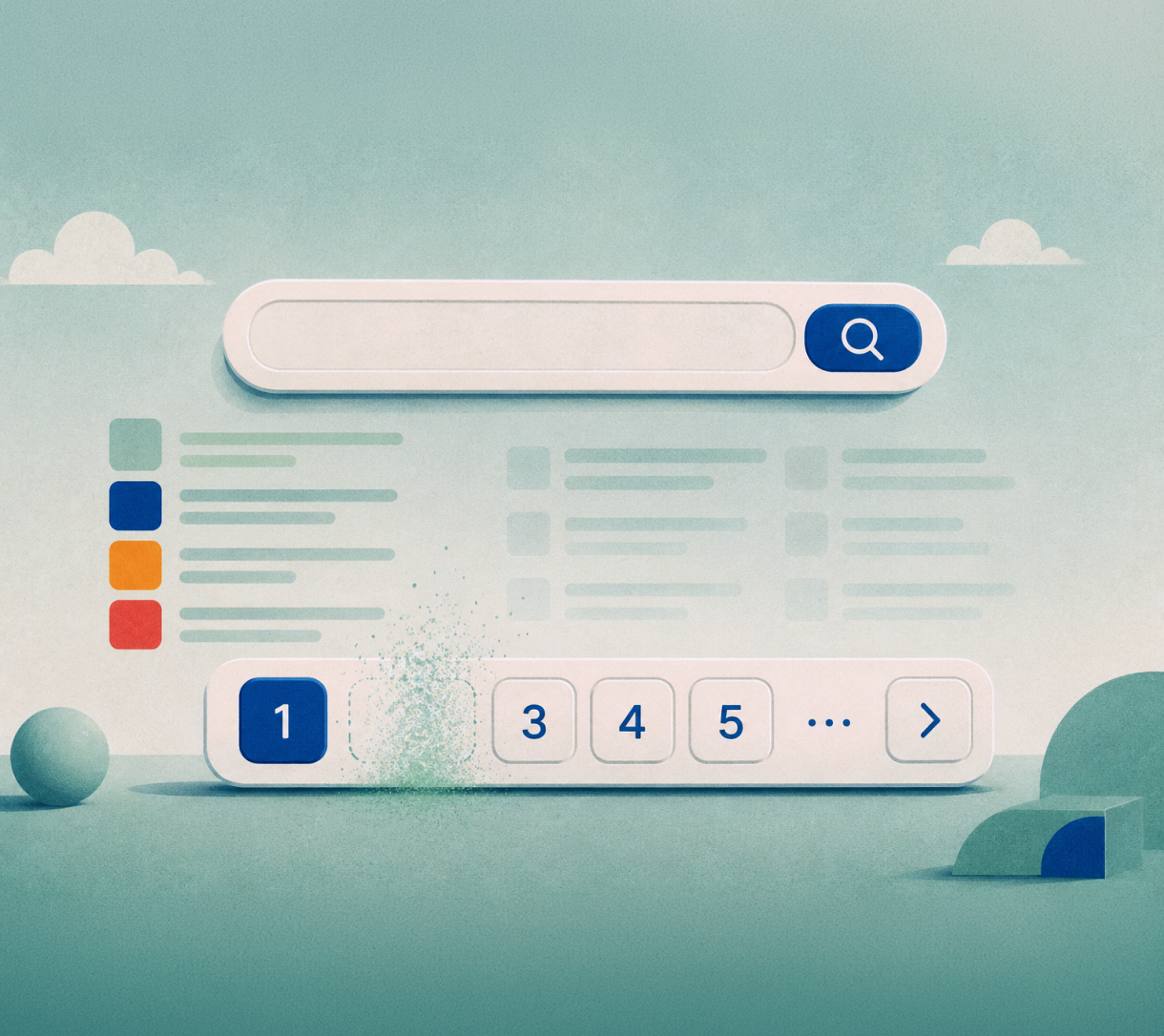
Almost nobody visits page 2 of Google. Backlinko's analysis of 4 million search results found that just 0.63% of clicks go to page-2 results, while the top result collects 27.6% of them and earns roughly ten times the clicks of position ten. Google removed continuous scroll in June 2024 after concluding that auto-loading more results didn't make searchers happier. Results below the first screen barely exist. And if your brand isn't visible before someone starts scrolling, it's effectively invisible.
The best place to hide a body, the old SEO joke goes, is page 2 of Google. It turns out the joke flattered page 2. Today's search results have something worse than a second page problem: a visibility cliff. Second page of Google statistics read less like a traffic report and more like a coroner's report:
| Where the clicks go | Share of clicks |
|---|---|
| Result #1 | 27.6% |
| Result #10 | Roughly a tenth of result #1 |
| All of page 2, combined | 0.63% |
Source: Backlinko's analysis of 4 million Google search results.
For a while, Google tried to abolish page 2 altogether. Continuous scroll arrived on mobile in October 2021 and desktop in December 2022, quietly merging the pages into one endless feed. Then, in June 2024, Google turned it off. As Search Engine Land reported at the time, Google's stated reason was that loading more results automatically "didn't lead to significantly higher satisfaction with Search." Read that sentence again, slowly, if you have pages ranking eleventh. The experiment ended because the extra results weren't worth loading. People weren't using what came next.
So, does anyone go to page 2 of Google? A rounding error does. Everyone else stopped at the first screen. People, not Google, eliminated page 2. And that behavior, the answer arriving before the scroll, did not stay politely confined to page 2.
Page 1 Is Becoming the New Page 2
The force that killed page 2, answers arriving before the reader scrolls, is now shrinking page 1. In 2026, 68% of US Google searches end without any click, per SparkToro. When an AI summary appears, Pew Research Center found searchers click a traditional result on just 8% of visits, versus 15% when no summary is present.
Your dashboard still says you rank #1. The dashboard is telling the truth. It is just describing a smaller prize every quarter.
SparkToro's 2026 study put US zero click searches at 68.01% for the first four months of the year, up from roughly 60% in 2024. Pew's numbers explain where the clicks went: when an AI summary sits on the page, only 1% of visits produce a click on a source cited inside that summary, and searchers simply end their session 26% of the time, versus 16% without one. The AI Overviews click-through rate story is just as blunt further down the funnel. Amsive measured a 19.98% CTR decline on non-branded keywords that trigger AI Overviews, the exact queries where new customers used to find you.
Positions still exist. The prize attached to them keeps shrinking. A #1 ranking on a SERP is becoming less like winning the lottery and more like winning a trophy nobody comes to see.
What's Actually on Page 1 Now
Today's Google results page is an amalgam of AI-influenced SERP features rather than ten blue links. The SERP used to answer one question: "Where should I click?" Now it answers another: "Do I need to click at all?" The most common: AI Overviews, an AI-written summary with cited sources at the top of the SERP; People Also Ask, the expandable Q&A on almost every SERP; and generative product summaries on shopping queries. Each answers part of the query before any blue link is reached.
| SERP feature | What it is | What it means for marketers |
|---|---|---|
| AI Overviews (AIO) | AI-written summary with cited sources at the top of the SERP | The citation slots are the new top rankings, tracked in Gist GEO via Share of Citations |
| People Also Ask | Expandable Q&A boxes on almost every SERP | Each answer is an extraction target; question-formatted headings with direct answers win them |
| Generative product summaries | AI-assembled product info and grids on shopping queries | Product data arrives via merchant feeds rather than your product page |
| Featured snippets | The extracted answer box, the pre-AI ancestor | The original zero-click feature; the same extractability rules now feed AIO |
AI Overviews matter most on that list, because they are where the citations live. Which brings us to the real estate everyone is actually bidding on now. The most valuable real estate on Google's page has shifted from the ranking to the citation.
The New Front Page Is an AI Answer
The scarce real estate on the new page 1 is a citation inside the AI answer, and the vocabulary matters. A mention names your brand in the answer's text. A citation links your page as a source. A mention is exposure. A citation is traffic. One builds awareness. The other creates a path to action. Only the citation sends the reader, and rankings no longer guarantee you either one.
That last part deserves a number. In mid-2025, Ahrefs found that 76% of AI Overview citations came from pages ranking in the organic top 10. When it re-ran the study in March 2026, as Search Engine Journal reported, that figure had fallen to 38%. Part of the drop is methodological, and Ahrefs itself cautions the two datasets aren't directly comparable, but the direction is the point: a top-10 ranking has gone from nearly sufficient to nowhere near sufficient for citation. In other words, ranking well still helps. It just no longer guarantees AI will choose you as a source.
Getting cited, meanwhile, pays measurably. Seer Interactive's 2026 analysis of 5.47 million queries found that brands not cited in the AI Overview watched organic CTR on those queries decline 67% over 2025, while cited brands earned 120% more organic clicks per impression than uncited ones. Organic CTR on AIO queries bottomed at 1.3% in December 2025 and recovered to 2.4% by February 2026. The clicks that remain are consolidating around the cited few. SEO rewarded being discoverable. AI search increasingly rewards being citable. That is the scoreboard worth measuring.
Google AI Mode: Its Own Surface, Not a SERP Feature
One more thing prowls the results page, and it deserves separate mentioning because it does not live on the results page at all. Google AI Mode replaces the SERP with a Gemini-powered conversation. Searchers slide into it instinctively, often without registering the switch, and Google keeps promoting it hard. Per Google, AI Mode passed 1 billion monthly users within its first year. Similarweb measured its referral rate at 1.6 to 2.5% of queries, versus 17 to 19% for classic search. In AI Mode, the answer is the results.
A billion people using a search surface that sends a click out on roughly one query in fifty is not a trend a CMO gets to ignore.
What CMOs Should Do About It (Keep Ranking, and Prioritize AI)
Keep the SEO engine running, and prioritize AI visibility just as hard, because citations have joined positions as the KPI. Baseline where AI engines cite you today, restructure key pages so answers are extractable, and earn brand mentions on the sources AI already trusts. In Gist GEO, watch Share of Citations, Citation Rate, and Share of Voice first.
The playbook is mostly the same. The scoreboard is new. Here's where to start:
1. Baseline your citations. You cannot manage a scoreboard you have never seen. Run a Gist GEO audit across the AI engines your buyers use, and log who holds the citations you don't.
2. Make your answers extractable. AI engines lift answers, so give them clean edges: question-formatted headings, a direct 40-to-60-word answer under each, tables where tables belong. This is the craft of answer engine optimization, and it doubles as good writing.
3. Build authority where AI already looks. Engines cite the sources they already trust, so earn your brand's presence on those domains: the review sites, communities, and publications that keep appearing in your category's answers. That earned layer is the slow, compounding work of generative engine optimization, and it is the part your competitors will skip.
For twenty years, marketers fought to win the click. The next decade will belong to the brands that first earn the citation.
Run a Gist GEO audit and see your citation baseline before next quarter's board deck asks for it.