
One correct citation can leave half an answer unsupported
Consider this invented example. A venue's page says it opens at 10 a.m. An answer cites that page for the opening time, then says parking is free without providing a source.
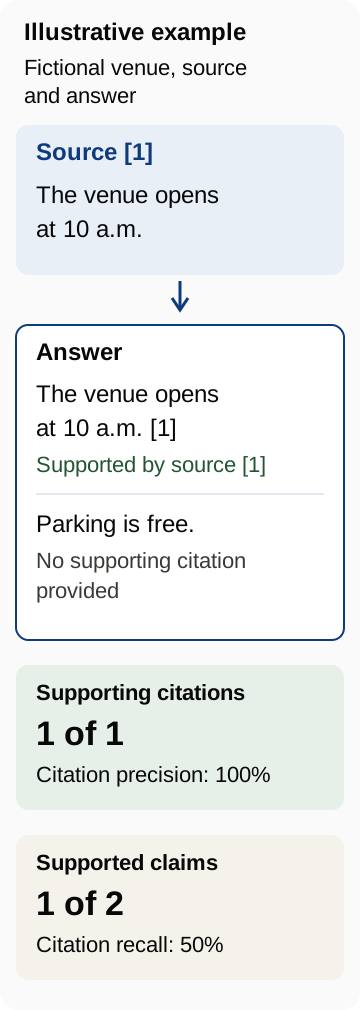
Illustration created for this article. It is not a saved AI answer, product screenshot or measurement result. The source and venue are fictional.
The single citation passes its check: one supporting citation out of one provided. The answer fails to support its parking claim: one supported claim out of two. Calling the first result “100% accurate” would tell a reader more than we checked.
The parking claim might be true. The example establishes that the answer has not supplied evidence for it. It also leaves a separate question open: whether the venue's page itself is accurate and current.
The 2023 audit measured two different denominators
A 2023 Stanford study evaluated four search systems using 1,450 queries each. Researchers collected first complete responses between late February and late March 2023. Human reviewers scored sentence-level citation support and citation-level support separately. A sentence could contain multiple claims. Read the study.
Scroll horizontally to read all columns. Use the focused table region with the arrow keys.
| System tested in 2023 | Citation recall: sentences fully supported | Citation precision: supporting citations |
|---|---|---|
| Bing Chat | 58.7% | 89.5% |
| NeevaAI | 67.6% | 72.0% |
| perplexity.ai | 68.7% | 72.7% |
| YouChat | 11.1% | 63.6% |
Query-level averages of the authors' per-response ratios (Tables 7 and 8), not pooled fractions or answer-accuracy scores. Partial citations counted toward precision when they jointly fully supported a sentence and none did alone. NeevaAI abstained on 22.7% of queries; each other system on less than 0.5%. These are historical results, not current performance.
Automated support scores still need a stated method
The separate 2023 ALCE benchmark, developed by Tianyu Gao and colleagues at Princeton, evaluated generated answers against retrieved passages. It used a language-inference model to judge whether the cited material supported each statement. It kept answer correctness and citation quality as separate evaluations. Read the ALCE paper.
ALCE's citation checks also considered sources together. A statement can need information from more than one passage; no single passage has to support every part of that statement. The method did not require the smallest possible set of citations. Its authors reported limits in the automated evaluator, including difficulty with partial support.
For someone reviewing a software demonstration, the implication is to ask for the rule behind a support score. Does the check inspect each claim and its associated passages? How does it handle a source that supports only part of a sentence? Which judgments were made automatically, and which were reviewed by a person?
Keep the citation and the supported claim in the same record
We recommend keeping the complete answer beside the exact cited URL and the passage used for the check. Mark the reviewed claim as supported, partly supported, unsupported or not assessable. If the page cannot be opened, record that limitation rather than guessing what it says. Keep the retrieval date so a later page edit does not silently replace the version you reviewed.
For the fictional venue, a useful record would say: “Opening time supported by the cited page; parking claim has no supporting citation.” That gives a business a specific fact to investigate while preserving the successful citation. It also avoids treating an unsupported sentence as proof that the entire answer is false.
A citation tells you where to start checking. The resulting evidence should say which statement the page supports, with the answer and source version available for someone else to inspect.
Sources and scope
This article interprets two papers published in 2023; primary papers were checked on November 10, 2026. It reports their methods and selected published results, with no new engine testing. The Stanford table retains all four evaluated systems and their separate rates. The fictional example demonstrates the denominators and is not part of either study.
Gist publishes this article and sells AI visibility software. The evidence standard described here applies equally to Gist and other vendors. A citation, a product mention and a recommendation remain different observations; our CRM research example shows why that distinction also matters.