ChatGPT-only saved-answer study
How ChatGPT frames car-care choices
Providers, conditions and sources across 30 questions — with a separate used-car buying module
A driver asking ChatGPT where to take a car receives more than a list of businesses. The answer may rank a chain, suggest an independent mechanic, introduce a booking platform, explain what belongs in a quote, or warn that a particular branch matters more than the national name. For businesses trying to understand their place in that advice, being named is only the beginning of the research question.
The study covers choosing car-care providers and information resources, with a separate module on buying a used car. It examines 344 saved ChatGPT answers to 30 analyst-authored questions, collected on October 19, 2026 Pacific / October 20 UTC. Each question has 8–28 saved answers because the collection's stopping process allowed different numbers of repetitions. Those repetitions let us examine consistency and exceptions within a question; they are not independent shopper samples.
The panel contains 20 national car-care questions, four city-specific oil-change questions, two questions about comparison or estimate resources, and four about buying a used car. We keep the 312 service/resource answers separate from the 32 used-car answers. Within service, 288 answers concern provider selection and 24 concern information resources. Exact questions appear with the results and in the questionnaire.
“ChatGPT” identifies the provider in the saved exports. An exact underlying model/version and search configuration have not been established from those exports. The study describes this recorded collection, not every ChatGPT interface or today's answers. All 30 ChatGPT question runs completed.
Four results connect the chapters:
- The role can be more stable than the overall winner. Walmart recurs as a low-price option, while installation eligibility, competing quotes and local conditions determine whether it is the useful route. In the tire-price advice, Walmart’s price role coexists with Discount Tire’s matching/value role.
- A strong heading can end in a conditional choice. The repair-network answers put NAPA first, then compare NAPA and TechNet at the shop level. Some explicitly prefer the better local shop over the longer advertised warranty.
- Stable shortlists can contain inconsistent details, and citations can accompany unfavorable advice. Tire-price answers disagree about Sam's Club Plus installation terms. Separately, battery-warranty answers cite Costco's own page while qualifying its coverage unfavorably. The latter is a source/advice relationship, not evidence of factual error.
- Local and transactional details remain consequential. A national preference need not identify a branch. A convenient used-car dealer need not be available for home delivery or be the preferred route for every kind of protection.
These are findings about the saved advice. The study did not buy services, compare invoices, test shop quality or measure business outcomes. Its value is more specific: it shows what a marketer, operator, publisher or researcher must inspect to understand where an organization participates in an AI-mediated decision.
The first part develops the service findings across oil changes, tires, batteries, brakes, maintenance, booking and local selection. A separate part examines used-car search and buying. The final chapters bring sources and robustness together, then translate the evidence into bounded audit questions rather than promises of improved visibility.
Engine boundary: AI Overviews is excluded because collection and content integrity remain unresolved; failed or empty captures are not coded as zero visibility. Perplexity does not enter this report's findings or denominators. Google-inclusive conclusions remain unavailable.
Oil changes: a stable shortlist still leaves price, waiting and sales pressure unresolved
Question group · ChatGPT · October 19, 2026 Pacific collection. Each n is saved answers to that exact question.
Scroll sideways to read all table columns.
| ID | Exact question | n |
|---|---|---|
| AUTO-01 | Which national chains would you recommend for a routine oil change? | 16 |
| AUTO-02 | Which oil-change chains are best for a low-cost full-synthetic oil change, including the usual fees? | 8 |
| AUTO-03 | Which oil-change chains are best if I want a quick visit without an appointment? | 16 |
| AUTO-04 | Which oil-change chains would you recommend if I want to avoid pressure to buy extra services? | 8 |
Four national questions make oil changes the clearest service comparison in the panel. They ask about a routine visit, low-cost full-synthetic service including fees, speed without an appointment, and avoiding pressure to buy extras. The complete cells contain 16, eight, 16 and eight ChatGPT answers, respectively: 48 answers altogether. These are different authored tasks, not an experiment changing one isolated condition.
The routine question gives Valvoline an explicit best-overall label in 16/16 answers. Two qualifications accompany that label: one answer gives Firestone an equal five-star score, and another makes Valvoline and Firestone first choices for different purposes. Walmart already appears as a budget route. The price question does not discover it from nowhere; it elevates that existing role.
When the question specifies low-cost full-synthetic service including usual fees, Walmart receives an explicit price/value preference in 8/8. Midas or Meineke coupons remain potential competing routes. The answers do not obtain comparable final quotes for a specified vehicle and branch. “Preferred for price” describes the advice, not a verified national price advantage.
The speed question separates the overall label from the fastest-service label. Every answer labels Valvoline best overall and Take 5 best for speed. Every answer also qualifies advertised service time with the queue or the total visit. AUTO-03-E02 explains:
“A less-busy shop can easily be faster than a chain advertising 10-minute oil changes.”
The answer does not abandon its chain comparison. It identifies another variable that can determine whether the driver's objective is achieved. Two answers put Take 5 first in the final time table while leaving Valvoline at the top of the initial ranking. That is a change of comparison dimension, not necessarily conflicting advice.
Exhibit 1. Four oil-change questions produce different kinds of priority
Scroll sideways to read all table columns.
| Exact task and question ID | Repeated result | What still determines the decision |
|---|---|---|
| “Which national chains would you recommend for a routine oil change?” AUTO-01, 16 answers | Valvoline overall label: 16/16 | Local branch quality and alternatives remain; two answers complicate a sole-winner reading. |
| “Which oil-change chains are best for a low-cost full-synthetic oil change, including the usual fees?” AUTO-02, 8 answers | Walmart price/value preference: 8/8 | Vehicle, fees and competing coupons require a final quote. |
| “Which oil-change chains are best if I want a quick visit without an appointment?” AUTO-03, 16 answers | Valvoline overall label and Take 5 speed label: 16/16 each | Waiting-time qualification: 16/16. Advertised minutes are not measured total visit time. |
| “Which oil-change chains would you recommend if I want to avoid pressure to buy extra services?” AUTO-04, 8 answers | Express first chain to investigate: 7/8; Take 5: 1/8 | Specific-location evidence: 8/8. Independent-mechanic route: 6/8. |
Each fraction uses its own complete question cell. Do not add them to produce a national preference share.
The pressure question is the strongest challenge to treating the national shortlist as the endpoint. Express leads the first-chain comparison in seven answers, but six answers also offer an independent mechanic. The exception that starts with Take 5 subsequently says it would favor a well-reviewed independent mechanic if avoiding pressure matters more than the fastest visit. Every answer asks the reader to assess the actual location.
Even the stated evidence for the chain comparison deserves scrutiny. Seven of eight explicitly distinguish customer satisfaction from low-pressure selling. References to a J.D. Power study use 2025 in five answers, 2026 in one and 2023 in another; the remaining answer uses Consumer Reports. We have not adjudicated those survey claims in this edition. The stable Express-first pattern is therefore not proof of a stable factual basis, nor evidence that other chains behave dishonestly.
For a chain operator, the chapter identifies three distinct appearances to assess: a national task-fit label, a branch-level qualification, and a claimed basis for the recommendation. A visibility report that retains only the first will miss both the conditions under which an alternative is favored and factual details that require verification. The study supports auditing those fields separately. It does not establish that changing a branch page or a price statement would change the answer.
Evidence: all AUTO-01–04 ChatGPT records. Complete-response reading covers every answer in these four cells.
Tires: the answer connects a purchase, an installer and a future service relationship
Question group · ChatGPT · October 19, 2026 Pacific collection. Each n is saved answers to that exact question.
Scroll sideways to read all table columns.
| ID | Exact question | n |
|---|---|---|
| AUTO-05 | What are the best places to buy tires and have them installed? | 12 |
| AUTO-06 | Where should I buy tires if I want the lowest total cost including installation? | 8 |
| AUTO-07 | Which websites make it easiest to buy tires online and arrange local installation? | 8 |
| AUTO-08 | Which tire retailers are best if I want warranty service and tire maintenance available nationwide? | 8 |
The four tire questions address general purchase and installation, lowest installed cost, online purchase with local fitting, and nationwide aftercare. All 36 answers were read: 12 for AUTO-05 and eight each for AUTO-06–08. The key distinction is who performs which part of the transaction.
Discount Tire receives a coherent overall/top-choice label in all 12 general purchase-and-installation answers. Costco is the membership/value alternative in all 12, Walmart the budget alternative, and Tire Rack the research/selection route with installation partners. Eleven also suggest comparing a local independent shop. These are different ways to complete the job, not merely runners-up in one retailer ranking.
The price-focused cell turns that distinction into a shopping sequence. Walmart has a low-upfront-price role in 8/8; Discount Tire has a matching/value role in 8/8. Five answers explicitly advise obtaining a competing installed quote and asking Discount Tire to beat it. AUTO-06-E07 says:
“Find the cheapest installed price at Walmart, then ask Discount Tire to beat it.”
That is a proposed strategy in the answer, not a finding that Walmart has the cheapest actual quote. A retailer may supply the benchmark while another remains a potential purchase destination. The same cell warns against confusing a package benefit with the total cost: one answer notes that free fitting does not help if the tires themselves cost more. Tire model, installation, disposal, service packages and membership conditions must be compared together.
Online purchase, installation and aftercare follow different routes of the online-installation cell
In the eight online-installation answers, Discount Tire is first-listed five times, Tire Rack twice and SimpleTire once.
Exhibit 2. Online installation: initial ordering versus functional advice
Scroll sideways to read the full chart. Exact data and qualifications follow.

Scroll sideways to read all table columns.
| First substantive listed website, AUTO-07 | Answers | Function retained across the cell |
|---|---|---|
| Discount Tire | 5/8 | Purchase and fitting at its own locations |
| Tire Rack | 2/8 | Research/selection with a separate installer network |
| SimpleTire | 1/8 | Online purchase and booking with independent local installers |
Exact question: “Which websites make it easiest to buy tires online and arrange local installation?” All eight saved ChatGPT answers were read. First-listed is a structural observation, not a count of exclusive recommendations.
The closing advice matters as well. AUTO-07-E07 puts Tire Rack first with a best-overall heading, then says Discount Tire would be its first choice if a location is nearby. It closes with three routes: Discount Tire for one-company service, SimpleTire for an independent shop, and Tire Rack for research and selection. Its Tire Rack discussion also warns that a fitting appointment may need to be arranged separately.
The broad pattern is stable even as the initial website changes: buying the tire, booking the appointment, paying the installer and obtaining follow-up service are related but distinct actions. A marketplace with many installers does not necessarily offer one integrated appointment or uniform aftercare.
Nationwide access is different from entitlement to a benefit
Discount Tire retains an overall/top-choice label in all eight nationwide warranty-and-maintenance answers, and every answer qualifies its geographic coverage. Walmart supplies geographic or rural-access breadth in all eight; Costco supplies member/included benefits; Firestone supplies a combined tire-and-general-repair route.
AUTO-08-E03 makes the installer-network boundary explicit:
“[I]nstallation availability doesn't necessarily mean that every location will provide the same complimentary maintenance or warranty services.”
Another answer distinguishes service access from replacement stock. A network may be present without having the exact tire available. These conditions explain why an apparently stable overall preference is not a promise that the driver can obtain the needed benefit anywhere.
Policy detail is less stable than the shortlist
The lowest-installed-cost answers give inconsistent descriptions of Sam's Club Plus installation. Four describe eligible four-tire installation as free; two describe it as half-price; two do not specify the Plus amount. These are conflicting saved claims, not a determination of the current policy or a measured error rate.
Exhibit 3. One membership benefit, three saved descriptions
Scroll sideways to read all table columns.
| AUTO-06 claim | Count | Records |
|---|---|---|
| Free installation for eligible Plus members buying four tires | 4/8 | E02, E03, E04, E07 |
| Half-price installation / $40 for four | 2/8 | E00, E06 |
| No specific Plus amount | 2/8 | E01, E05 |
The source relationship adds another distinction. Walmart plays the low-price role in all eight answers, but a Walmart-family URL appears in only three citation lists. A Discount Tire-family URL appears in all eight. That is evidence of separate advice and citation outcomes; it does not establish which page produced the advice.
For retailers and installation platforms, the useful study result is a map of functions: quote benchmark, matching destination, installer, booking coordinator and aftercare network. The online cell varies in its ordering, while the price cell contains a repeated-policy inconsistency.
Evidence: all AUTO-05–08 ChatGPT answers. Exact questionnaire and complete response records accompany this report. Current services, prices and warranty terms were not verified for this chapter.
Batteries: a cheap product, an installed replacement and a successful warranty claim are different outcomes
Question group · ChatGPT · October 19, 2026 Pacific collection. Each n is saved answers to that exact question.
Scroll sideways to read all table columns.
| ID | Exact question | n |
|---|---|---|
| AUTO-13 | Which retailers would you recommend for buying a car battery and having it installed? | 8 |
| AUTO-14 | Where should I buy a replacement car battery if I want a low price with installation included? | 8 |
| AUTO-15 | Which mobile services are best for replacing a car battery at home the same day? | 24 |
| AUTO-16 | Which car-battery retailers are best for a straightforward warranty replacement if the battery fails early? | 8 |
The battery module contains four complete questions and 48 ChatGPT answers: eight each on buying with installation, low installed price and straightforward warranty replacement, plus 24 on same-day replacement at home. All were read. The larger mobile cell must not become three times the weight of another task in a combined battery ranking.
In the broad purchase-and-installation question, Walmart has the price/value role in all eight answers. Other priorities bring Advance Auto Parts or O'Reilly forward. Two answers explicitly label Advance best overall; another gives O'Reilly the all-around/convenience role. The final recommendations compare retailers rather than establish one unconditional choice.
Costco exposes a particularly useful limit of list position. It appears as a buying option in four answers, including twice as the first main-list item. All four say installation is generally unavailable or must be arranged separately. The answer can favor a battery purchase without identifying a complete solution to the requested purchase-and-installation task.
The low-price question is more consistent: every answer explicitly starts with Walmart. That still depends on the compatible battery, an eligible installation and a participating location. The answer's next step is to establish the total for a particular vehicle, not to treat the quoted battery price as a finished job.
EverStart, DieHard, Duralast and Super Start are product families within this advice. Adding them to Walmart, Advance, AutoZone and O'Reilly as if they were eight competing retailers would misdescribe the decision. Brand, retailer and installation provider need separate fields.
Exhibit 4. The battery task changes the next action
Scroll sideways to read all table columns.
| Exact question | Complete cell | Repeated finding | Necessary distinction |
|---|---|---|---|
| AUTO-13: “Which retailers would you recommend for buying a car battery and having it installed?” | 8 | Walmart price/value role: 8/8 | Costco appears in 4/8, with separate/unavailable installation in all four. |
| AUTO-14: “Where should I buy a replacement car battery if I want a low price with installation included?” | 8 | Walmart first price starting point: 8/8 | Eligible battery, vehicle and location still need confirmation. |
| AUTO-15: “Which mobile services are best for replacing a car battery at home the same day?” | 24 | AAA overall heading: 24/24; YourMechanic rapid option: 20/24 | Three endings put YourMechanic first for speed; all 24 qualify availability. |
| AUTO-16: “Which car-battery retailers are best for a straightforward warranty replacement if the battery fails early?” | 8 | AutoZone overall ranking: 7/8 | Walmart leads the other answer. Testing eligibility is distinct from warranty duration. |
A same-day heading does not settle who to contact first
AAA's overall label repeats in all 24 mobile answers, but YourMechanic is offered as a rapid-service option in 20. Three answers explicitly put YourMechanic first in their closing contact order for speed; another jointly checks AAA and YourMechanic first. Several branch on whether the driver is already an AAA member.
AUTO-15-E23 provides the contrast directly:
“YourMechanic: Best option to check first for a fast appointment.”
The same answer gives AAA the best-overall heading but makes speed the deciding criterion for the first contact.
Every mobile answer qualifies availability. One states that no recommended service can guarantee a same-day appointment without checking location and vehicle. All 24 ask for location. Advertised response times in the text are not arrivals measured by this study.
The wider field also mixes organizations and routes. Interstate appears as a brand-specific mobile option in 18 answers; a local mobile mechanic or specialist route appears in 18. The text alone does not establish that every national name supplies a separate corporate or fulfillment choice. Those identity questions remain open rather than inflating the competitor count.
Warranty duration does not measure an easy claim
AutoZone leads the warranty ranking in seven answers. The eighth starts with Walmart for warranty value and gives AutoZone a convenience role. The report therefore cannot turn this cell into an unqualified statement that ChatGPT always chooses AutoZone.
All eight distinguish a defective battery from one that is merely discharged or passes a test. Seven explicitly disclaim measured claim-approval or customer-satisfaction performance. Other qualifications concern receipts, store access, proration, whether replacement restarts the warranty, and which product tier was purchased. A longer stated term alone does not answer whether a failed battery qualifies or how easily a claim is handled.
The Costco result is especially important for interpreting citations. All eight warranty answers cite its automotive-batteries page, and all eight qualify its coverage unfavorably because the answer describes it as prorated. AUTO-16-E06 says:
“Costco can still be attractive on price, but I wouldn't choose it specifically for warranty protection.”
Exhibit 5. Owned citation alongside unfavorable task advice
Scroll sideways to read all table columns.
| AUTO-16, all eight answers | Count |
|---|---|
| Costco automotive-batteries page cited | 8/8 |
| Costco receives an unfavorable warranty qualification | 8/8 |
The saved URLs use two query-string variants of the same host/path, occurring seven times and once. These are not independent policy confirmations. The exhibit does not establish that the citation caused the advice or verify the current policy.
This chapter supports evaluating a complete job: compatible battery, installation, appointment and later service. It also shows that a company's own page is cited alongside advice that discourages choosing it for a particular priority. Positive presence, negative qualification and source participation are distinct outcomes.
Evidence: all AUTO-13–16 ChatGPT responses. Every policy, price and response-time description remains attributed to the dated model answers.
Brakes and maintenance: price comparison and trust require more than a chain name
Question group · ChatGPT · October 19, 2026 Pacific collection. Each n is saved answers to that exact question.
Scroll sideways to read all table columns.
| ID | Exact question | n |
|---|---|---|
| AUTO-09 | Which auto-service chains would you recommend for brake pad and rotor replacement? | 12 |
| AUTO-10 | Which brake-service chains are best for an affordable pad and rotor replacement? | 12 |
| AUTO-11 | Which brake-service providers are best if I want a repair warranty honored nationwide? | 12 |
| AUTO-12 | Which brake-service providers would you recommend if I am worried about being sold work I do not need? | 12 |
| AUTO-17 | Which auto-service chains would you recommend for routine scheduled maintenance on a car that is out of warranty? | 8 |
| AUTO-25 | Which repair-estimate websites would you recommend for checking a brake replacement quote? | 16 |
| AUTO-26 | Which independent websites are most useful for comparing auto-service chains? | 8 |
The four brake questions contain 48 answers, 12 each: general pad-and-rotor replacement, affordability, nationwide warranty, and concern about unnecessary work. A further eight answers address out-of-warranty scheduled maintenance. Reading them together shows how an apparent provider competition becomes a question about work scope, credentials and continuing care.
The general chain question gives Firestone an explicit first/best starting-point recommendation in all 12 answers. Rival prominence varies: Pep Boys is an option in 11, Meineke in ten and Midas in nine. Some endings start with a pair of providers despite the body's Firestone ranking. Even this stable starting point should not be counted as 12 exclusive choices.
The affordability cell is much less stable in its first-ranked chain. Meineke leads five answers, Midas four, Brakes Plus two and Pep Boys one. What remains consistent is the quote-comparison procedure. All 12 distinguish new rotors from resurfacing or narrower work included in an advertised package. Ten also advise obtaining an independent-shop quote.
Exhibit 6. The first chain varies; the work-scope warning does not
Scroll sideways to read all table columns.
| AUTO-10: affordable pad-and-rotor replacement | Saved answers |
|---|---|
| Meineke first in the main ranked list | 5/12 |
| Midas first | 4/12 |
| Brakes Plus first | 2/12 |
| Pep Boys first | 1/12 |
| Distinguishes rotor replacement from resurfacing/narrower package work | 12/12 |
| Offers an independent-shop comparison quote | 10/12 |
Exact question: “Which brake-service chains are best for an affordable pad and rotor replacement?” The first four rows partition list order; the last two are overlapping advice features. They are not verified price rankings.
AUTO-10-E09 calls Midas best overall value, but begins its closing quote list with Pep Boys for the best price/reliability combination. We retain both signals. A strict ordering code treats them as conflicting first-stop signals; a broader reading can preserve two comparison options. Neither reading justifies manufacturing an exclusive winner.
The independent-resource question about checking a brake quote adds 16 answers. RepairPal is called best overall in all 16, but its role is a benchmark rather than the workshop performing the repair. The answers distinguish pads from pads plus rotors and front/rear or axle scope. They do not explicitly mention shop fees or warranty in this cell. That omission is bounded to these saved answers, not a general finding about ChatGPT.
The practical distinction is between assessing the scope and price of work and establishing whether the work is needed. An estimate can inform the former. It does not inspect a rotor. This is why quote resources, a second opinion and a selected shop cannot be counted as equivalent recommendations.
Warranty and trust broaden the provider routes
The nationwide-warranty question makes Firestone the explicit primary starting point in nine answers and NAPA AutoCare in three. NAPA's leads occur in the middle of the sequence, not merely at an endpoint. Two answers additionally favor Christian Brothers for longer parts-and-labor protection. These findings describe how the text weighs different stated terms and access routes; they are not a comparison of actual claim handling.
When the question asks which providers to consider because the driver is worried about unnecessary work, all 12 identify an AAA-approved facility as a first/top starting route, and all 12 also recommend an established independent mechanic. Those categories overlap. AAA approval is not an ownership type or a single national repair chain. A few answers permit a dealer for specialized work or a well-reviewed chain as an alternative.
This change partly reflects the questionnaire: the baseline asks for chains, while the trust question allows providers more broadly. It cannot show that mentioning concern about unnecessary work alone causes chains to lose recommendations. It also does not establish that chains are dishonest.
A best-chain label can sit inside an independent-shop recommendation
The maintenance question asks: “Which auto-service chains would you recommend for routine scheduled maintenance on a car that is out of warranty?” Its eight answers give Goodyear the best-chain label six times and Firestone twice. All eight also offer an independent-shop route.
AUTO-17-E03 is explicit:
“For a car that's out of warranty, I generally favor a reputable independent mechanic over a national chain.”
The answer still ranks Goodyear among chains. Another answer's closing shortlist starts with an AAA-operated center, while a different one starts with an AAA-approved facility. Ownership and approval remain separate.
All eight distinguish a straightforward quick-lube job from responsibility for a broader maintenance schedule. Seven explicitly point to the manufacturer's schedule or owner manual; the eighth does not. All cite the same Consumer Reports survey page, with URL parameters retained in the source record. Its survey details were not independently established for this report. Repeated attribution does not make a repair-experience survey a direct scheduled-maintenance ranking.
The chapter's recurring commercial result is a move from selecting a name to selecting a relationship: who defines the work, who provides the quote, what protection applies, and who will maintain the vehicle over time. The answer can give a chain a favorable label while asking the reader to investigate another route.
Evidence: complete AUTO-09–12, AUTO-17 and AUTO-25 ChatGPT cells. Prior detailed reading and codes are preserved; AUTO-10 was fully reread in this expansion. All service and policy assertions remain bounded to the saved advice.
Networks, booking and mobile maintenance: the named organization is not always the mechanic
Question group · ChatGPT · October 19, 2026 Pacific collection. Each n is saved answers to that exact question.
Scroll sideways to read all table columns.
| ID | Exact question | n |
|---|---|---|
| AUTO-18 | Which repair-shop networks are best if I want an independent mechanic and a repair warranty honored nationwide? | 12 |
| AUTO-19 | Which websites or apps are best for comparing prices and booking routine car maintenance? | 8 |
| AUTO-20 | Which mobile mechanic services would you recommend for routine maintenance at home? | 28 |
Three questions cover a nationwide repair network for an independent mechanic, price comparison and booking, and routine maintenance at home. Their complete cells contain 12, eight and 28 answers. All 48 were read. They show three ways an intermediary can participate before the actual work is assigned.
Network membership supplies a filter
NAPA AutoCare is first-listed and receives an overall or nationwide-availability label in all 12 network answers. TechNet is also recommended in all 12. Every ending directs the reader toward a NAPA/TechNet shop comparison, with the local shop, applicable warranty or both governing the decision.
AUTO-18-E06 calls NAPA its top choice for most drivers, then says:
“Between two equally reputable shops, I'd favor a TechNet facility offering a written 36-month/36,000-mile warranty over a NAPA facility offering 24 months/24,000 miles.”
AUTO-18-E07 supplies the counterweight to “longer warranty wins”:
“But I would choose an excellent independent shop with a 24-month warranty over a poorly reviewed shop offering 36 months.”
Both passages are the model's stated reasoning; the study has not verified those policies or the quality of any shop. The local shop and coverage terms determine the final choice.
Every answer retains a check on qualifying work, coverage or claims procedure. “Nationwide” is not treated as unlimited coverage of every repair. One answer also distinguishes RepairPal certification from a uniform nationwide repair warranty. Certification belongs in a screening column, not automatically beside warranty networks as an equivalent benefit.
The first platform in a list may not be the first step
The booking question asks: “Which websites or apps are best for comparing prices and booking routine car maintenance?” All eight answers use Openbay and CarAdvise for quotes/booking and RepairPal for price reasonableness. These are complementary functions.
Openbay is first-listed in five answers and CarAdvise in three. The proposed workflow has a different ordering: four start with CarAdvise, two with RepairPal, and two use the Openbay/CarAdvise pair without a unique first step. AUTO-19-E01 puts Openbay at the top of its main ranking but starts its saving strategy with CarAdvise. E07 starts by checking RepairPal's price range before proceeding to a booking choice.
Exhibit 7. Three jobs within a maintenance-booking answer
Scroll sideways to read all table columns.
| Function | Repeated participants in AUTO-19 | Why the distinction matters |
|---|---|---|
| Obtain competing prices and book | Openbay/CarAdvise pair: 8/8 | The platform coordinates access; it is not necessarily the workshop. |
| Check price reasonableness | RepairPal: 8/8 | A reference range can precede provider selection without being the booking destination. |
| Assess local reputation | Google Maps and Yelp: 5/8 each | Discovery/review resources have different pricing and booking capabilities. |
Counts overlap. They describe roles in eight saved ChatGPT answers, not market shares or independently tested platform features.
The requested specifications still matter. Some answers ask the reader to match oil, parts, labor and fees before comparing totals. Reported platform facts also vary: CarAdvise network-size claims differ across answers, including 25,000, 26,000 and 30,000, with different geographic wording. This report does not decide which is correct. It keeps the claims separate from the observed advice.
A stable mobile lead has several different final partners
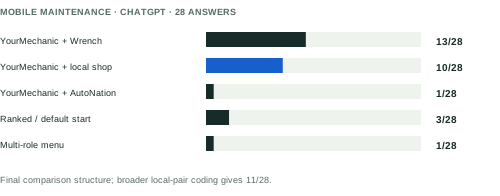
YourMechanic is first-listed in all 28 home-maintenance answers. It has a best-overall or best-starting-point label in 27; the other says best for routine maintenance. Wrench is offered in 27. Yet the final comparison is not always that pair.
Exhibit 8. What the ending actually asks the reader to compare
Scroll sideways to read the full chart. Exact data and qualifications follow.
Scroll sideways to read all table columns.
| Final structure, AUTO-20 | Answers |
|---|---|
| Explicitly compare YourMechanic and Wrench first | 13/28 |
| Explicitly compare YourMechanic with a local independent | 10/28 |
| Compare YourMechanic and AutoNation first | 1/28 |
| YourMechanic-first/default or ranked start | 3/28 |
| Multi-role menu without one final pair | 1/28 |
Exact question: “Which mobile mechanic services would you recommend for routine maintenance at home?” Categories partition the 28 full answers. One additional YourMechanic-first answer suggests a local comparison without explicitly pairing the starting choices; a broader local-pair definition gives 11/28 rather than ten.
An unnamed local-independent route appears somewhere in 23 answers. It is not one additional national brand. The answer often asks about insurance, experience, written terms or continuity with the person doing the work.
The repeated reading also changes the account of specialist alternatives. The first answer's Goodyear Mobile Garage appears in only two of 28, and Discount Tire Mobile Installation in one. Later answers add AutoNation, Spiffy and several differently named tire or oil services. Similar “GoMobile” names have different displayed domains; the study does not merge them into one company. Wrench/YourMechanic and AutoNation/RepairSmith relationships are asserted in some outputs but not independently established here.
All 28 request location or ZIP details before claiming to narrow the recommendation to available providers. Some reserve equipment-intensive work for a shop or appropriately equipped specialist. The national name therefore identifies a starting route, not a confirmed appointment or a guarantee that every job can be completed at home.
Across these three cells, the useful outcome is the proposed sequence: screen a network member, compare like-for-like quotes, establish the local mechanic, and verify the service. Headline prominence alone cannot tell an operator which part of that sequence it occupies.
Evidence: complete AUTO-18–20 ChatGPT cells. The exact questions, full-answer codes, conditional counts and identity uncertainties are in the portable companion.
Local oil-change advice: a recurring chain does not identify one recurring branch
Question group · ChatGPT · October 19, 2026 Pacific collection. Each n is saved answers to that exact question.
Scroll sideways to read all table columns.