
The main test supplied five sources to GPT-3.5
The researchers built a benchmark of 10,000 queries, including search datasets and generated questions. The main evaluation used its 1,000-query test split. For each query, the system retrieved the top five Google results and supplied source text to GPT-3.5 Turbo.
For each question, the researchers randomly selected one source to modify and kept that source fixed across the different editing methods. The comparison was with the unmodified source. Methods included adding quotations or statistics and improving fluency. The answer-generation prompt required responses to use the supplied sources. Sections 2.2.2, 3.1 to 3.4 and Appendix B.1.
The controlled setup makes the content comparison possible. It also means an improvement in the resulting answer cannot tell us whether publishing that edit would cause a search system to select the page more often. The authors explicitly say they did not evaluate effects on search rankings. Section 9.
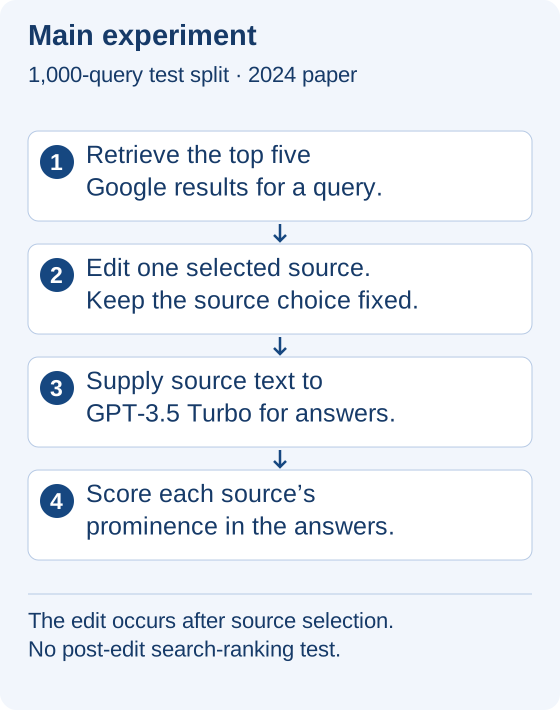
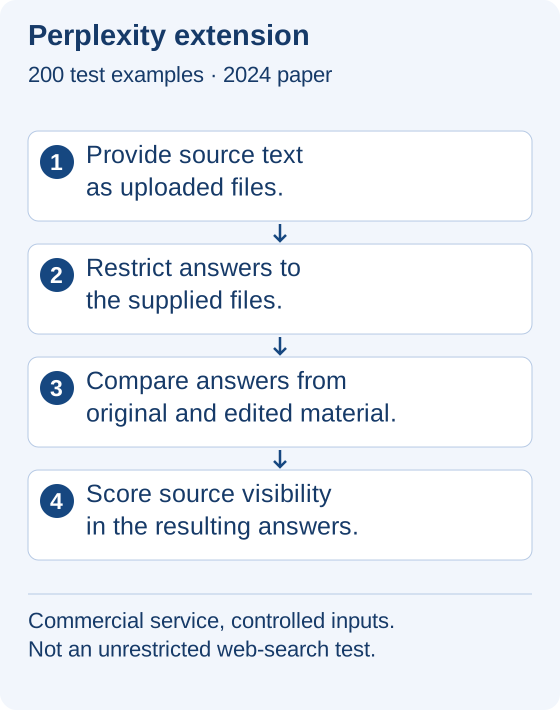
An explanatory diagram of the published methods, not a captured interface or a new Gist experiment. Main test: 1,000 queries. Perplexity extension: 200 test examples. Source: Sections 2.2.2, 3 and 9, and Appendix C.1 of Aggarwal et al., June 2024.
Visibility was a score inside the answer
The main metric counted words in sentences that cited a source and gave earlier sentences more weight. The paper divided sentence credit when multiple sources were cited, then normalized citation impressions within each response. Its other main metric used model judgments of citation relevance, influence and related qualities, including estimated likelihood of clicking.
Those measures describe how a source is represented in an answer. The model's click estimate is not a recorded click. Neither metric measures how many people visited a site, bought something or received a recommendation for the company behind the cited page. Sections 2.2.1 and 3.4.
The distinction changes the interpretation of the headline percentage. The paper's abstract reports visibility improvements of up to 40%. Table 1 gives a position-adjusted word-count score of 19.3 before optimization and 27.2 with quotation addition. That is a change in the paper's score, with the baseline as the denominator. It is not a count of additional readers.
There is also a reporting wrinkle: appendix Table 6 lists 19.8 and 27.1 for those same labeled rows. We preserve the table labels and do not combine them into one precise effect estimate. The central finding here depends on the experiment's design and metric definition, not resolving that discrepancy. Table 1, appendix Table 6.
Perplexity was tested with uploaded source files
The paper also evaluated a commercial service, Perplexity.ai. This is relevant evidence beyond the researchers' own answer-generation system, but the input method matters.
Appendix C.1 says the researchers uploaded source text as files and restricted answers to those files because the service did not let them specify source URLs. This extension used 200 examples from the test set. It therefore tested how the service answered from provided material, rather than observing whether an edited public page would be selected during unrestricted web search. Appendix C.1.
That does not invalidate the extension. It identifies the result it can establish: another answer-generating system responded differently to edited source material under the stated conditions. The paper's historical Perplexity setup is not a description of the service's current features.
Match the experiment to the outcome you need
For a publisher, more substantial attribution inside an answer may be a useful outcome in its own right. For a business trying to reach new customers, source attribution is only part of the question. The same cited page could support an explanation that never suggests buying from its owner.
An evaluation of a proposed content change can keep those outcomes separate:
Scroll horizontally to read all columns. Use the focused table region with the arrow keys.
| Decision | Evidence needed |
|---|---|
| Did the edited page become easier to find? | Comparable retrieval or search-selection evidence before and after the edit, with other changes considered. |
| Did the answer give the page more prominence? | Saved answers and a defined source-visibility measure, such as the one examined in this paper. |
| Did the answer recommend the business? | The actual advice, read separately from its source links. |
| Did people visit or become customers? | Traffic and business records, with an appropriate attribution method. |
This is our interpretation of the measurement boundary, not a claim that the paper promised all four outcomes. The study offers evidence that editing supplied text can change its representation in generated answers under the tested conditions. Whether those edits help a particular live site get found or chosen requires a different observation.
Source and scope
Primary source: Aggarwal, Murahari, Rajpurohit, Kalyan, Narasimhan and Deshpande, GEO: Generative Engine Optimization, KDD 2024, DOI 10.1145/3637528.3671900, arXiv v3, June 28, 2024. We checked the paper's HTML and PDF on November 9, 2026. This article analyzes the published design; it is not an independent replication, a survey of current assistants or an estimate of future citation gains.
The cited arXiv version is available under CC BY 4.0. Gist wrote this explanatory adaptation and drew the diagrams; the paper's authors have not reviewed or endorsed this article.
Gist publishes this article and offers AI visibility software. The same distinction between a research score, a source link, a recommendation and a business result applies to claims made by Gist.