ChatGPT-only saved-answer study
How ChatGPT assembles a home search and sale
Portals, representation and transaction support across 30 questions
Real estate businesses enter AI advice at different moments. A portal helps someone discover a property. A directory or referral service introduces an agent. A brokerage may supply representation, while another company offers a cash purchase, financing or help preparing a home for sale. Public resources can answer an important question without introducing any commercial provider. Across the saved advice, a familiar starting point is repeatedly followed by a different check before the reader should rely on it.
This report examines how those roles are assigned in 280 saved ChatGPT answers to 30 analyst-authored questions, collected on October 19, 2026 Pacific / October 20 UTC. All 30 ChatGPT runs completed. Each contains 8–16 saved answers, allowing the research to examine recurring advice and meaningful exceptions within each question. The repetitions are outputs from the collection process, not independent homebuyer samples.
The panel covers five home-search questions, five agent-selection questions, five representation questions, five selling-route questions, six research/guidance questions and four matched first-time-buyer questions naming cities. The intended context is the United States. Exact questions and sample counts precede the results in each chapter and appear together in the appendix.
The strongest result is a division of responsibility. Zillow's broad-search role differs from Redfin's listing-freshness role; freshness advice still calls for confirmation. An agent directory is different from a matching form that initiates contact. In the saved advice, MLS exposure does not itself provide negotiation or closing help, and a convenient cash offer does not settle net proceeds or contractual certainty.
Four patterns organize the report:
- Discovery and verification use different resources. Mainstream portals remain prominent, while new-construction and foreclosure questions introduce specialist routes. The answers distinguish a visible listing, confirmed availability and a property condition that still needs checking.
- The recommended service may be an introduction rather than representation. Agent-matching, review and privacy questions assign different roles to HomeLight, Zillow, Realtor.com and FastExpert. Brokerage names coexist with repeated attention to the actual agent and the agreement.
- A selling service is a bundle of responsibilities and obligations. Flat-fee listing, an investor offer, buying before selling and funding preparation solve different problems. The relevant comparison includes what remains for the homeowner to arrange.
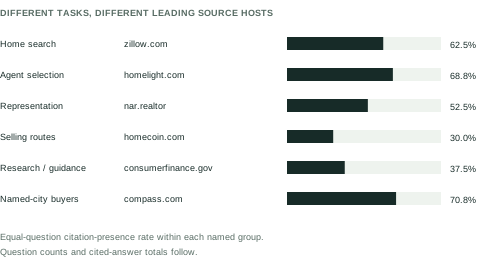
- Advice and source presence require separate analysis. The most frequent recorded citation hosts differ by task. Their standings also change when questions with more saved answers receive more weight. None of those measures alone establishes the preferred provider.
The report is written for real estate operators, marketers, publishers and researchers trying to understand their place in this advice. It analyzes what the outputs say and how consistently; it does not verify current service terms, professional performance or consumer outcomes.
“ChatGPT” is the saved provider label; the exact underlying model/version and search configuration are not established by the selected exports. AI Overviews remains excluded because capture and content integrity are unresolved. Failed or empty Google records are not coded as no visibility. Perplexity does not enter this edition's findings or denominators. A comprehensive Google-inclusive account remains an unfinished research goal.
Zillow opens the search; availability and specialist inventory bring other routes
Question group · ChatGPT · October 19, 2026 Pacific collection. Each n is saved answers to that exact question. RE01–30 abbreviate RE-B1-01–30.
Scroll sideways to read all table columns.
| ID | Exact question | n |
|---|---|---|
| RE01 | Which websites or apps are best for starting a home search, and what is each most useful for? | 8 |
| RE02 | Which home-search websites are worth using when I want to avoid outdated listings or homes that are already under contract? | 8 |
| RE03 | Which home-search websites or apps are most useful for comparing homes remotely through video tours, floor plans and other property details? | 8 |
| RE04 | Which websites are best for finding newly built homes and comparing builders? | 8 |
| RE05 | Which websites are useful for finding foreclosure and bank-owned homes, and how do their listings differ from mainstream home-search sites? | 8 |
The five home-search questions contain 40 ChatGPT answers, eight per question. They distinguish beginning a search, avoiding stale listings, viewing remotely, finding new construction and finding foreclosure or bank-owned property. The strongest repeat result is not the disappearance of the familiar portals. It is the allocation of different jobs around them.
For starting a search, Zillow is first-listed in 8/8 answers. Zillow, Realtor.com, Redfin and Homes.com receive substantive roles in all eight, and every ending combines resources rather than choosing one exclusively. Google Maps also appears in every answer as a location or commute resource. GreatSchools and Trulia each appear as separately ranked options in three, showing how the surrounding research resources vary even when the core portal set stays stable.
That makes the main comparison wider than a list of substitutes. In these answers, a portal supplies inventory or price context, while a map or school resource addresses a different part of the decision. Counting the names together would hide that division of labor.
Freshness changes the starting point, but does not remove the final check
Redfin replaces Zillow at the top of the freshness question in 8/8 answers. All eight also recommend Realtor.com for cross-checking and retain Zillow with a qualification about confirming availability. Every answer includes a local MLS or agent route and acknowledges that an accepted offer can precede a listing-status update.
The meaningful distinction is between a preferred search interface and confirmation that a seller is still accepting offers. RE02-E07 states (the reference identifies question RE02 and saved-answer index 7):
“My recommendation: Use Zillow for research and discovery, then verify availability through Redfin, Realtor.com, or the listing agent.”
The same answer calls for an agent-created active-listing search. Its national portal ranking therefore does not remove the local verification step. Nor has this study measured any portal's actual update speed: it records the hierarchy of resources in the model's advice.
Exhibit 1. A stable first option sits inside a broader search workflow
Scroll sideways to read all table columns.
| Exact task, all ChatGPT answers | First-listed option | What the complete advice retains |
|---|---|---|
| Start a home search, RE01; n=8 | Zillow: 8/8 | Four core portals and Google Maps: 8/8; complementary workflow: 8/8 |
| Avoid outdated listings, RE02; n=8 | Redfin: 8/8 | Realtor.com cross-check and local MLS/agent route: 8/8; update-lag qualification: 8/8 |
| Compare homes remotely, RE03; n=8 | Zillow: 8/8 | Listing-specific feature limits and agent-assisted live viewing: 8/8 |
| Find new construction, RE04; n=8 | NewHomeSource: 8/8 | Zillow price comparison: 8/8; community-specific review or investigation: 7/8 |
| Find foreclosure/bank-owned homes, RE05; n=8 | Auction.com: 7/8; Foreclosure.com: 1/8 | Stage-dependent resource combinations and pre-foreclosure warning: 8/8 |
First-listed means the first substantive ranked option. Features in the final column can overlap. These are full-response semantic observations in five complete question cells, not tests of the services or causal effects of wording. Exact questions appear above.
Remote viewing adds a capability boundary
Zillow also leads all eight remote-viewing answers, but the tool set remains complementary. Every answer qualifies the availability of tours and floor plans at the listing level. Every answer recommends or offers a live, agent-assisted viewing as a step beyond static or prerecorded material.
Matterport appears as a separately ranked option in seven answers. It is described as tour technology rather than an ordinary inventory portal. That matters to a visibility analysis: a technology used inside listings may participate without being a competing place to find the property.
RE03-E02 asks for a live walkthrough “so you can inspect areas not shown in marketing photos.” Only two answers explicitly extend the warning to odors, noise, hidden conditions or structural problems. The report therefore distinguishes the universal listing-feature qualification from the narrower property-condition warning. A generic statement that every answer gives a complete remote-inspection warning would overstate the evidence.
Specialist inventory adds a different kind of uncertainty
NewHomeSource is first in all eight new-construction answers. TrustBuilder is presented through or alongside that service in all eight, rather than as an unrelated competing portal. Zillow remains a price/location comparison resource in all eight.
The deeper condition concerns the particular development. Seven answers direct review or investigation to a specific community or local division; six explicitly say the same builder's quality or experience can vary by location. Six also distinguish the advertised base price from a fuller purchase price involving upgrades or other additions. RE04-E06 urges research into “the specific community and construction team, not just the national brand.” These are qualifications in the saved advice, not independent findings about any builder's work.
The foreclosure question further separates finding a record from finding a purchasable home. Auction.com leads seven answers and Foreclosure.com one, while every ending combines resources by stage or goal. All eight warn that a pre-foreclosure entry does not necessarily mean the home is for sale. All eight give substantive roles to HUD Home Store, Fannie Mae HomePath and Freddie Mac HomeSteps, alongside mainstream comparisons. Seven explicitly distinguish an opening bid from a final purchase price; seven add a county/public-record route.
For a portal, specialist marketplace or data provider, the chapter establishes several kinds of participation: discovery, comparison, a technical viewing feature and confirmation. The most prominent name can remain useful while the answer sends the reader elsewhere to establish whether the property, price or condition is what it appears to be.
Matching, comparing proposals and controlling contact are different agent-selection tasks
Question group · ChatGPT · October 19, 2026 Pacific collection. Each n is saved answers to that exact question. RE01–30 abbreviate RE-B1-01–30.
Scroll sideways to read all table columns.
| ID | Exact question | n |
|---|---|---|
| RE06 | Which agent-matching services are worth trying for a first-time home purchase, and how do they choose the agents they suggest? | 8 |
| RE07 | Which services are useful for comparing local real estate listing agents, including their proposed fees and services, before choosing one? | 16 |
| RE08 | Which real estate agent-matching services are useful when moving to another state and looking for an agent with relocation experience? | 12 |
| RE09 | Which websites are most useful for checking a real estate agent's recent sales and client reviews before contacting them? | 8 |
| RE10 | Which services let me compare real estate agents without immediately sending my contact details to several agents? | 8 |
These five questions contain 52 saved answers: eight on first-time-buyer matching, 16 on comparing listing-agent fees and services, 12 on relocation matching, and eight each on researching an agent and limiting early contact. Each cell was read in full. The repeated advice distinguishes generating candidates from checking them and deciding whom to contact.
HomeLight is first-listed in all eight first-time-buyer answers, but every ending uses more than one service. Six include HomeLight and UpNest; two start with HomeLight and Clever instead. RE06-E05 states:
“Start with HomeLight and Clever, compare at least three agents, and interview your top two before signing a representation agreement.”
UpNest remains in that response as a fallback if the initial services do not identify a comfortable choice. This is a change of role within one answer, not a rejection of the provider. The first response's HomeLight/UpNest combination is consequently a recurring pattern, not the only final route in the cell.
All eight answers also qualify sales-volume or performance evidence as insufficient to establish patient first-time-buyer support. They describe participating networks as incomplete and distinguish Zillow's research role from its commercial connection process. The recurring decision is to create a shortlist, then test fit rather than allow a platform's match to settle it.
The fee question favors proposals, not merely another match
UpNest is first-listed in all 16 answers about comparing listing-agent fees and services. HomeLight appears in all 16 with a performance/experience matching role. Clever appears as a discounted-agent option in 15; the remaining answer uses UpNest, Seeking Agents and HomeLight in its closing set.
Every answer requests comparable written fee/service proposals. The comparisons include marketing, photography or staging, contract duration, cancellation and total service; they also distinguish the listing fee from possible buyer-agent compensation. These are descriptions of the outputs' evaluation criteria, not this report's statement of current fees or legal obligations.
There is an identity problem within the displayed field. RealChoice is separately numbered in six answers. Five explain a relationship to UpNest/Realtor.com; RE07-E13 lists UpNest and RealChoice in both its table and top-three choices without explaining that linkage. The archive therefore supports a count of displayed routes, but not an automatic count of independent companies. The report does not resolve ownership through inference from the names.
Seeking Agents appears as a proposal/detail option in five answers. Redfin appears in two as a benchmark from a brokerage's own service, a different role from an open matching marketplace. Those alternatives make the question about the form of comparison as well as the provider label.
Exhibit 2. The agent-selection task determines the route described
Scroll sideways to read all table columns.
| Task and complete cell | Prominent starting point | What the full response adds |
|---|---|---|
| First-time matching, RE06; n=8 | HomeLight first: 8/8 | Shared service ending: 8/8; HomeLight/UpNest in six, HomeLight/Clever in two |
| Listing-agent proposals, RE07; n=16 | UpNest first: 16/16 | Comparable written fees/services: 16/16; HomeLight and Clever perform different comparison roles |
| Relocation matching, RE08; n=12 | HomeLight first: 11/12; Agent Pronto: 1/12 | Multiple services in every ending; actual relocation experience requested: 12/12 |
| Check sales/reviews, RE09; n=8 | Zillow first/best-overall heading: 8/8 | Zillow + Realtor.com + Google Reviews in every ending; individual/team attribution warning: 8/8 |
| Limit early contact, RE10; n=8 | Zillow first: 8/8 | Directory browsing before introductions: 8/8; Homes.com in three final starting sets, FastExpert in five |
The measures distinguish initial list position from the full workflow. Service descriptions, fees and privacy practices were not tested. Exact questions and per-cell n appear above; supporting response IDs and feature definitions are in the reading register.
Relocation fit is more specific than local sales activity
HomeLight heads 11 of the 12 relocation answers. Agent Pronto heads the exception, RE08-E10. HomeLight remains in all final sets, but none is an exclusive single-service choice. UpNest appears in six final sets, Agent Pronto in four and Clever in three, with the latter sometimes conditional on selling as well as buying. Five endings also use a directory as an independent cross-check.
Every answer asks for actual relocation capabilities, such as prior out-of-state buyers, live tours, remote inspections/closing or coordination across markets. A high-volume local agent and someone able to manage a remote purchase are not treated as identical qualifications.
HomeLink is distinct from HomeLight and appears in five answers; four qualify its advertised screening or track-record claims. These remain dated output claims, not verified current performance.
Researching an agent is not the same as asking for an introduction
For checking sales and reviews, Zillow has the first/best-overall heading in all eight answers, while every ending combines Zillow, Realtor.com and Google Reviews. All eight warn about whether a transaction belongs to an individual or a team. Six explicitly discuss incomplete records; three add public licensing checks. The answer thus assembles different kinds of evidence rather than treating one profile as a complete assessment.
The contact-control question produces a different boundary within the same platforms. All eight recommend directory browsing before requesting introductions. FastExpert receives a positive directory role in six answers, while the first answer cautions about its matching flow. HomeLight's matching/contact tradeoff is explicitly cautioned in five.
The distinction is the action: view a profile, request a match or contact a chosen agent. Three answers explicitly discuss tracking or the absence of guaranteed anonymity. One introduces MyHomeAgent but requires confirmation of its data practices. This research has not tested any form or privacy practice; it shows why a single positive/negative label for the company would discard the condition that gives the advice its meaning.
Brokerage prominence gives way to the agent, service scope and agreement
Question group · ChatGPT · October 19, 2026 Pacific collection. Each n is saved answers to that exact question. RE01–30 abbreviate RE-B1-01–30.
Scroll sideways to read all table columns.
| ID | Exact question | n |
|---|---|---|
| RE11 | Which real estate brokerages with broad U.S. coverage are worth comparing for buying a home, and what are the main differences in their services? | 8 |
| RE12 | Which full-service real estate brokerages are worth comparing for selling a home, particularly for marketing support and help managing the sale? | 8 |
| RE13 | Which brokerages or buyer-agent services are worth considering if I want to reduce the cost of buyer-agent representation? | 12 |
| RE14 | Which real estate brokerages or relocation services are useful for coordinating a home sale in one state and a purchase in another? | 12 |
| RE15 | Which brokerages or buyer-agent services are worth considering when buying a newly built home and wanting representation separate from the builder's sales team? | 8 |
The representation module contains 48 answers: eight each on broad-coverage buying brokerages, full-service selling and new-construction representation, and 12 each on reducing buyer-agent costs and coordinating an interstate move. The questions ask about organizations, but the answers repeatedly return the choice to the person and work actually supplied.
For buying through a brokerage with broad U.S. coverage, RE/MAX is first-listed in five answers and Keller Williams in three. All eight emphasize the actual local agent and the negotiated agreement rather than national branding alone. RE11-E03 puts it plainly:
“The individual agent's experience matters more than the brokerage's advertising.”
Redfin's own/direct agents and agents reached through a partner route are explicitly distinguished in six of eight. That is consequential to the meaning of the name: being directed to the platform does not always imply the same employment relationship or service arrangement.
Selling support is evaluated at the delivery level
The full-service seller question puts Compass first in five answers and Coldwell Banker in three. Every answer qualifies the national service description by the actual agent, team, office or delivery. Every answer asks for a comparison of compensation and included services.
Three specifically warn that private or premarket marketing can affect broad buyer exposure. Three name Coldwell Banker's RealVitalize as a preparation program, and two recommend considering an independent local brokerage. Those are different observations: a marketing channel, a program within a brokerage relationship and an alternative provider. They should not become three interchangeable “competitors” in one extraction.
The output's evaluation is concrete: who will market the home, what the seller receives and what exposure or contract conditions accompany it. The study does not establish that one brokerage's actual marketing performs better.
A lower representation fee is not automatically the buyer's savings
The cost-reduction question has more variation in its first option. Prevu leads seven of 12 answers, ShopProp three, Trelora one and Redfin one. All 12 nevertheless include a route involving negotiated local or independent representation. All 12 qualify the choice by geography and the amount of assistance the buyer needs.
Exhibit 3. Initial options in the buyer-agent cost question
Scroll sideways to read the full chart. Exact data and qualifications follow.

Scroll sideways to read all table columns.
| First substantive option, RE13 | Saved answers / 12 | Full-response context |
|---|---|---|
| Prevu | 7 | Rebates or reduced compensation remain conditional on the transaction and service |
| ShopProp | 3 | A flat-fee/rebate comparison route, not a guarantee of lowest total cost |
| Trelora | 1 | Its stated pricing model varies across the repeated answers |
| Redfin | 1 | The ending of this answer prioritizes negotiated independent representation |
Exact question: “Which brokerages or buyer-agent services are worth considering if I want to reduce the cost of buyer-agent representation?” ChatGPT, all 12 saved answers. First-listed is a textual ordering measure; all 12 retain local negotiation, service-scope and geographic conditions.
Eleven answers explicitly say that a lower agent fee does not automatically become cash, price savings or closing-cost savings for the buyer. RE13-E10 says its figures compare compensation, “not necessarily your out-of-pocket expenses.” That answer opens with Redfin but later prioritizes independent flat-fee or reduced-percentage agents. Another opens with Prevu and closes with Houwzer first. The initial brand and the final cost-priority route are different fields.
The repeated reading also exposes variability inside provider descriptions. Trelora is offered in ten answers, but the accounts include commission sharing subject to a minimum, state-specific flat-fee examples, a conditional percentage and one answer saying no universal discounted fee was established. Some explicitly acknowledge differing page limits or caps. This is variation in the saved model claims, not a verified timeline of changing prices. A single current-looking percentage lifted from one response would discard that uncertainty.
For a brokerage assessing its appearance, the useful comparison therefore includes both the fee mechanism being described and the work or eligibility attached to it. A rebate, a lower agreed fee and a limited-service arrangement are not equivalent benefits.
Coordinating a move requires more than two introductions
Berkshire Hathaway HomeServices is first-listed in all 12 interstate-coordination answers and remains a closing starting point. Coldwell Banker appears in all 12; RE/MAX and Cartus in 11 each. The latter is presented as relocation management, usually with an employer or eligibility qualification, rather than simply another local brokerage.
Every answer distinguishes active coordination from a basic referral, and every answer separates employer-sponsored requirements from a privately funded move. RE14-E01 states:
“A basic referral connects you with two separate agents.”
The missing capability in that basic arrangement is someone overseeing the combined timing and responsibilities. HomeLight appears in three answers specifically for buy-before-you-sell financing or equity timing, a different role from its matching function in the preceding chapter. National reach, referrals, relocation administration and financing participate in the same move without supplying the same service.
New construction changes the final priority
Redfin leads six of the eight initial lists for representation independent of a builder's sales team; NAEBA leads two. The final prioritized comparison has a different structure. Five begin with a NAEBA/buyer-only brokerage route and three with a local new-construction specialist. Those are the first routes in conditional comparisons, not eight exclusive final recommendations.
Exhibit 4. First in the provider list is different from first in the final priority comparison
Scroll sideways to read all table columns.
| RE15 measure, all eight ChatGPT answers | Observed distribution | What is being selected |
|---|---|---|
| First substantive initial option | Redfin 6/8; NAEBA 2/8 | Initial prominence in the answer |
| First route in final prioritized comparison | NAEBA/buyer-only brokerage 5/8; local specialist 3/8 | Type of independent representation to investigate |
| Actual-agent builder expertise and independence | 8/8 | Capability and advocacy conditions |
| Advance/first-visit registration warning | 8/8 | A stated compensation condition requiring verification |
NAEBA is an association/directory route toward a member buyer-only brokerage, not itself the individual's representing agent. Seven answers explicitly describe that intermediary role. The registration statements are saved model claims about compensation, not a finding that a buyer loses the ability to hire representation.
Every answer prioritizes actual builder-specific experience and independent advocacy. Seven explicitly distinguish Redfin direct and partner agents. Matching services such as Clever, HomeLight or UpNest may help locate or compare candidates, but are not automatically the party providing representation.
This is the clearest distinction in the chapter: the national name can introduce the options while the final recommendation concerns independence, expertise and an actual agreement. The evidence supports retaining those qualifications, not replacing the initial list with a new unqualified winner.
Selling services differ in who does the work, supplies the money and carries the risk
Question group · ChatGPT · October 19, 2026 Pacific collection. Each n is saved answers to that exact question. RE01–30 abbreviate RE-B1-01–30.
Scroll sideways to read all table columns.
| ID | Exact question | n |
|---|---|---|
| RE16 | Which flat-fee MLS listing services are worth comparing, and how much help does each provide beyond putting a home on the MLS? | 8 |
| RE17 | Which websites or services are most useful for selling a home without a traditional listing agent? | 8 |
| RE18 | Which companies are worth comparing if I want a cash offer for my home and a predictable closing date? | 12 |
| RE19 | Which services help homeowners buy their next home before selling their current one, and what are the main costs or limitations? | 16 |
| RE20 | Which home-selling services help pay for repairs or preparation before a sale, and what fees or obligations come with that help? | 8 |
The selling module contains 52 answers: eight each on flat-fee MLS services, selling without a traditional listing agent and preparation funding; 12 on cash offers; and 16 on buying before selling. These are different jobs. Combining their names into one seller-service ranking would place listing software, professional assistance, investors and financing arrangements on the same scale.
MLS exposure leaves transaction responsibilities to resolve
Houzeo is first-listed in six of the eight flat-fee MLS answers, Beycome in one and Homecoin in one. Homecoin, Houzeo and List With Freedom receive substantive comparison roles in all eight. Beycome appears in seven; Congress Realty in four; Flat Fee Group and FSBO.com in three each. Every ending is a conditional comparison.
The more stable result concerns work scope. All eight distinguish listing exposure or tools from negotiation, contracts and closing support. All eight require checking the total fee and local MLS/package availability. RE16-E00 states:
“Access to blank forms is not the same as professional contract assistance.”
RE16-E01 makes the parallel distinction between an offer dashboard and negotiation help. The stronger countercase to treating Houzeo's six leading positions as unconditional preference is RE16-E05. It leads with Homecoin and cautions that Houzeo's percentage-based packages can become substantial as the sale price rises. That is the model's comparison, not a verified price assessment.
The no-traditional-agent question extends the workflow. Zillow is first-listed in all eight answers for an advertising/discovery role, but every answer combines MLS exposure, responsibilities retained by the seller and selective professional legal/closing help. The first answer's “Flat-fee MLS + attorney + professional photography” combination is a useful expression of that division. Homecoin appears in seven answers and is absent from the exception; its first-answer value label is not universal.
RE17-E03 also distinguishes Redfin's buyer-attraction role from direct owner listing. A destination where potential buyers see a home need not be the service the seller hires to place it on the MLS.
A cash offer still has an actual buyer and contractual conditions
Opendoor leads all 12 cash-offer lists, and both Opendoor and Offerpad are substantive options in every answer. In RE18-E07, however, the closing priority list puts Offerpad first. The cell therefore supports consistent Opendoor prominence without establishing an exclusive whole-answer preference.
The other actors have different roles. HomeLight Simple Sale appears as a cash-buyer network in six answers. Sundae appears as an investor marketplace in two. HomeVestors/We Buy Ugly Houses appears as one presented affiliated investor/franchise route in eight, rather than two independent competitors. An unnamed local cash-buyer route appears in 11.
All 12 require comparisons of net proceeds and some combination of inspection, funds, offer finality, cancellation or closing conditions. RE18-E01 says:
“A cash offer doesn't automatically guarantee a closing date.”
The report has not tested those transactions or contracts. The finding is that the saved advice separates an advertised offer route from the conditions that make the transaction dependable. A service that introduces bidders and a company that becomes the buyer should not receive the same role label merely because both appear in the cash-offer answer.
Exhibit 5. Five selling tasks distribute responsibility differently
Scroll sideways to read all table columns.
| Question and complete cell | Repeated observation | Responsibility or obligation that remains visible |
|---|---|---|
| Flat-fee MLS, RE16; n=8 | Exposure versus transaction support distinguished: 8/8 | Forms, dashboards and distribution do not themselves establish negotiation or contract help |
| No traditional listing agent, RE17; n=8 | MLS plus retained seller work and selective professional help: 8/8 | Advertising and completing the sale are different services |
| Cash offer, RE18; n=12 | Opendoor and Offerpad compared: 12/12; net/contract checks: 12/12 | Direct buyer, buyer network and investor marketplace are different actors |
| Buy before selling, RE19; n=16 | Conditional financing menus and backup-price risk: 16/16 | Equity access, an eventual purchase guarantee and coordinated moving solve different problems |
| Preparation funding, RE20; n=8 | Non-sale repayment warning: 8/8 | Deferring payment does not remove repayment or contract obligations |
ChatGPT-only full-cell observations. Exact questions appear above. The table summarizes the model's advice and qualifications; it does not verify current financing, legal terms, closing performance or service availability.
Buying first separates liquidity from protection against a slow sale
Knock and Orchard appear as substantive options in all 16 buy-before-sell answers. Flyhomes appears in 14, Homeward in 12 and HomeLight in eight. The first answer omits Homeward, so its shorter roster would understate a substantial route in the complete cell.
The first positions vary: Knock nine, HomeLight five and Orchard two. Every ending maps options to priorities and includes traditional bridge-loan or home-equity-line alternatives. Every answer discusses backup-price risk and overlapping-property or repayment exposure.
RE19-E01 gives the conceptual distinction:
“A bridge loan can solve a temporary cash shortage, but it does not necessarily protect you from being unable to sell your previous property.”
The observed roles include equity access, a cash-backed purchase, brokerage coordination and a fallback purchase arrangement. Some answers also discuss mortgage-qualification support. The same name can sit in several of those roles, and names do not necessarily identify independent financing suppliers. RE19-E10 asserts that Orchard uses HomeLight financing. That remains an unverified saved affiliation claim, but it prevents silently treating the displayed names as proven independent alternatives.
The economic descriptions also need their units retained. RE19-E02 adds program and buying/selling brokerage percentages to a roughly 7.9% starting figure without establishing that all percentages use the same home value or loan amount. Later, the same answer warns that the bases can differ. The research records this comparability problem rather than reproducing the number as an all-in cost. A percentage on the old home, the new home and the amount borrowed cannot be assumed to use a common denominator.
Preparation funding: paying later is still an obligation
Compass Concierge heads all eight preparation-funding lists. Compass and Curbio are substantive options in all eight; RealVitalize appears in six, Revive in five and Redfin Concierge in four. All eight warn that repayment may become due without a completed sale, and all compare improvement costs with net proceeds rather than treating a higher sale price as sufficient evidence of gain.
RE20-E01 captures the recurring distinction:
“Pay-at-closing does not necessarily mean pay-only-if-you-sell.”
Seven answers distinguish Curbio's renovation/project work from provider-specific or third-party financing. Six explicitly warn against assuming older zero-interest or pay-at-closing descriptions remain current. The exception, RE20-E06, uses agreed-project-price language without that financing distinction. All four answers that mention Redfin Concierge treat its original fee description as historical rather than a guaranteed current offer.
Provider roles vary inside the alternatives as well. Notable appears once as a standalone financing comparison and elsewhere as Compass's financing provider. HomeLight Buy Before You Sell is explicitly distinguished from dedicated repair funding in two answers; Simple Sale is offered once as a way to avoid repairs through an as-is sale. Avoiding the work, financing it and coordinating it are different answers to the homeowner's problem.
For operators and researchers, this chapter's durable result is the allocation of responsibility and risk. Prominent service names recur, but the complete advice specifies what the platform, professional, buyer, lender and homeowner each would have to do. That allocation is more informative than a pooled count of companies appearing in “selling” answers.
Research resources answer questions that an agent shortlist cannot
Question group · ChatGPT · October 19, 2026 Pacific collection. Each n is saved answers to that exact question. RE01–30 abbreviate RE-B1-01–30.
Scroll sideways to read all table columns.